POINT OF INTEREST  CHURCHES

Church of Consolation

In the Middle Ages, at the foot of the village of Castiglion Fiorentino, there stood a small shrine containing an image of the Madonna and Child attributed to Luca Signorelli.

×

More information :

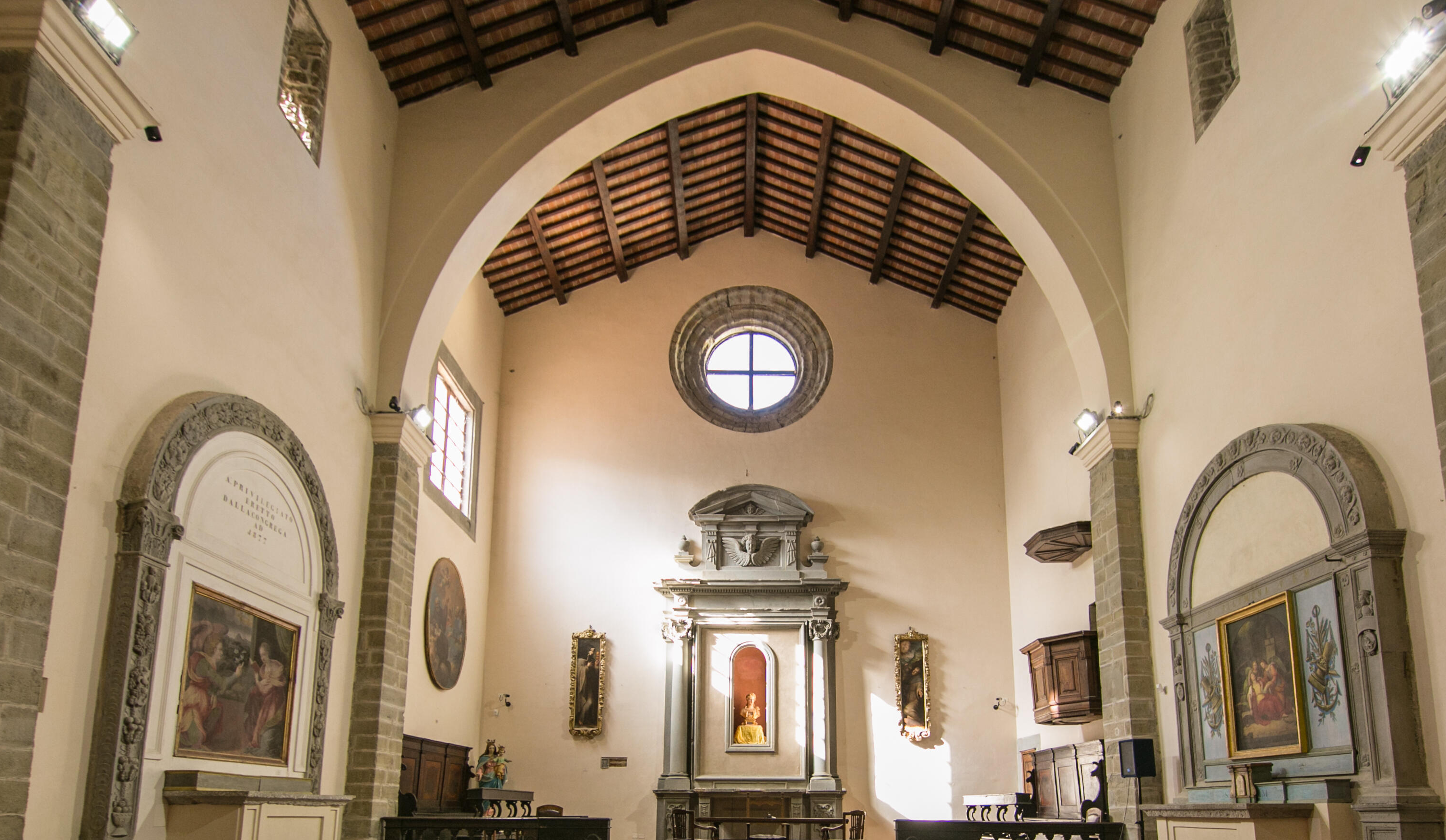
In the Middle Ages, at the foot of the village of Castiglion Fiorentino, there stood a small shrine containing an image of the Madonna and Child attributed to Luca Signorelli. Eleonora of Toledo, wife of Cosimo I de' Medici, after regaining her sight by praying before the tabernacle, had a temple built in homage to the image.

The cornerstone of the Church of the Madonna della Consolazione was laid in 1565, and construction continued for approximately forty years. The building has an octagonal central plan and is externally divided in two by a wide cornice: the lower section, in Doric style, features alternating rectangular windows and niches, while the upper section, in Ionic style, is embellished with large oculus. We have no certain information about the author of this extraordinary work. Some believe it is clearly the work of Vasari; others believe the church is based on a design by the famous architect Antonio da Sangallo.

The work was completed in 1607, but just a year later, following incessant rains, the dome collapsed; it was then decided to build a simple pyramidal roof. Inside, in a side chapel of the octagon, an altar by Berrettini containing a fresco of the Madonna was placed. On the morning of June 9, 1967, lightning again caused the roof to collapse, and the church was reopened only 16 years later.
How to Get Here

Address:

Via della Consolazione, 4, 52043 Castiglion Fiorentino AR
52043 Castiglion Fiorentino (Ar)

View in Maps

Share the page

Below are our references through which you can contact us:

You might also be interested in ...

Drag or swipe the images for a more immersive experience.

Church of Sant'Agostino

View More

Museo Archeologico

The Civic Archaeological Museum of Castiglion Fiorentino was founded in 2001 to exhibit the materials found during archaeological investigations carried out in the area

View More

Castle of Montecchio Vesponi

The Montecchio Vesponi Castle is one of the most evocative fortresses in all of Tuscany.

View More

Porta Perugina

Al termine di una ripida scalinata è disponibile l'accesso occidentale al fortilizio del Cassero

View More

Palazzo Comunale

Political and administrative seat of Castiglion Fiorentino since the end of the 12th century, the Palazzo Comunale, or Palazzo San Michele, was rebuilt by the Perugians in 1375-76 and, subsequently, in 1489

View More

Loggiato Vasariano

In front of the Town Hall we find the so-called Vasari loggia: in reality the nine-arched construction, built on the occasion of the reconstruction of the current Town Hall square, dates back to 1513.

View More

Walks of Saint Francis

The Ways of St. Francis in Tuscany are a nearly 300-kilometer path that leads pilgrims and travelers to places linked to key episodes in the life of the Saint.

View More

Cassero

Located in the highest part of the town, the Cassero complex dominates the entire Valdichiana and still retains its medieval defensive structure.

View More

Church of Jesus

The building, constructed by the Congregation of the Most Holy Sacrament between 1527 and 1545, is adjacent to the ancient Parish Church of San Giuliano (Pieve Vecchia).

View More

Theater of Mario Spina

The history of the Teatro Comunale begins at the end of the 16th century, when the Grand Duke of Tuscany Ferdinand I authorized the Podestà of Castiglion Fiorentino to start an Academy to perform comedies.

View More